Pacemaker and defibrillator leads
Below you will find some detailed information I have put together about lead extraction and our approach at VELMAS. You may also find the 2011 Cardiology Patient Page on lead extraction from Circulation, the journal of the American Heart Association, helpful.
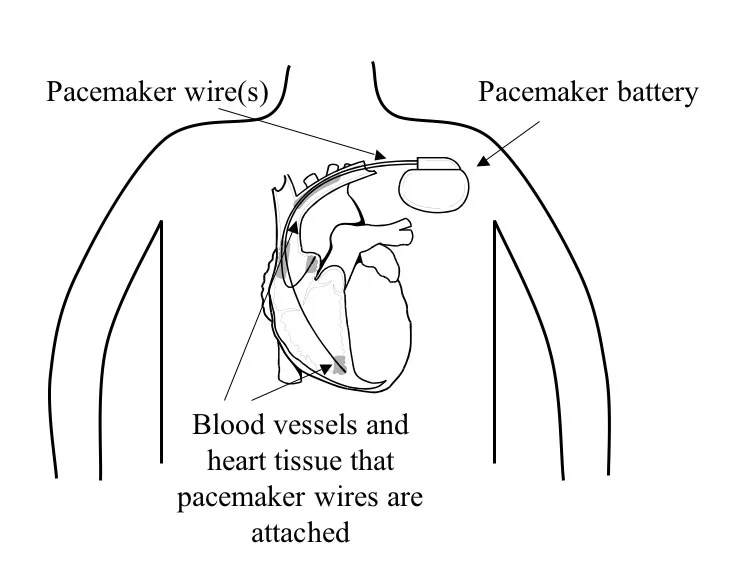
Further reading · Circulation, 2011 Pacemaker and Defibrillator Lead Extraction Cardiology Patient Page, American Heart Association · opens ahajournals.org ↗A pacemaker or defibrillator system consists both of the device placed under the skin and one or more leads connecting it to the heart. Leads are made of metal wire covered by plastic insulation. Pacemakers and defibrillators themselves are usually relatively easy to remove (you may have experienced this during a generator/battery change). However, the pacing leads lie within the blood vessels and heart and can become very scarred into these important structures.
Why does a pacemaker or defibrillator lead need to be removed?
The most common reason for lead extraction is infection with bacteria, either on the lead itself or around the pacemaker or defibrillator. The infection may be associated with erosion through the skin so that the device or leads can be clearly seen. Antibiotics may temporarily suppress the infection, but the body is not able to completely clear the germs until all artificial material has been removed. Chronic infection can lead to serious complications and may be fatal.
A lead may also need to be removed because it is broken or not working properly. Occasionally leads are removed because they are no longer required, because the blood vessels they lie in are blocked, or to allow an MRI scan, an operation or cancer treatment.
How are leads removed?
Scar tissue grows around the lead within the veins and the heart. This holds the lead in place and can make it difficult to remove.
The extraction operation is usually performed in a cardiac operating theatre, under general anaesthesia. A special ultrasound probe is passed into the food pipe and several small tubes may be inserted into veins and arteries in the arms and legs, to monitor you and to give you fluids or to be used in the case of emergency.
A cut is made over the device and the pacemaker or defibrillator is removed. A plastic tube (called a sheath) is inserted over the lead and pushed along its length. The sheath breaks up the scar tissue and allows the lead to be removed.
- Laser sheaths can be connected to a laser, which is very effective in breaking up the scar tissue.
- Cutting sheaths have small blades at the end to cut through the scar tissue.
- Snaring: sometimes a tube is inserted into a vein in the neck or leg so that the lead can be snared and pulled out.
- Open-heart surgery: very occasionally, this is the only way to remove the leads.
Sometimes, when leads have not been in place for long, it is possible to remove them without highly specialist equipment and with very low risk. In these cases, the extraction procedure can be performed in the cardiac catheter laboratory (similar to where your device was originally implanted). The advantage of this is that it can usually be arranged more quickly, and there is no need to have a general anaesthetic. The disadvantage is that removal is sometimes more difficult than expected and a second procedure may be required if I find that the leads cannot safely be removed without additional equipment.
Is lead removal successful?
More than 95% of all leads can be completely removed. In a small number of patients, the tip of the lead is left behind in the heart, but this usually does not cause any further problems. In rare cases a large portion of the lead cannot be removed and further treatment, if required, depends on the particular situation. Often these fragments do not need to be removed.
What are the risks of lead removal?
Because the lead may be stuck so tightly to the veins or the heart, the lead removal operation carries a 1–2% risk of a tear or perforation of one of these important structures. If this happens, life-threatening bleeding can occur, and emergency heart surgery is almost always necessary.
What 1–2% means
Out of 200 patients undergoing a lead extraction operation, approximately 3 will have such a serious complication.
If the lead has been implanted for a very long time, the risk of complications may be higher. In all but the most low-risk cases, lead removal is performed in an operating theatre with a cardiac surgeon and team standing by, and they can immediately step in to do the emergency surgery. Recovery from emergency surgery is usually good but may be slow and, occasionally, there may be long-term after-effects.
The risk of death from the procedure is small, about 2 in 1000. These risks are generally lower than the risks involved in open-heart surgery such as bypass surgery. Other serious possible complications include damage to heart valves, bleeding, blood clots which can occasionally travel to the lungs, and recurrent infection.
Will a blood transfusion be necessary?
A blood transfusion is not usually necessary for patients undergoing lead extraction. However, as standard, a blood sample is taken for crossmatch pre-operatively in case a blood transfusion is required during or after the procedure.
Who performs lead removal (extraction)?
Whilst many cardiologists in Australia implant pacemakers and defibrillators (ICDs), there are only a few who have undertaken the additional training and certification required to be able to remove them. A/Prof Gareth Wynn leads an experienced lead extraction team and patients are referred from all over Victoria, Tasmania as well as other States and Territories.
Almost all extraction procedures are performed at either The Royal Melbourne Hospital or Melbourne Private Hospital. The high success rate and low complication rate at RMH/MPH are comparable to the best results from other high-volume centres around the world.
When will another pacemaker or ICD be implanted to replace the one removed?
This depends on the reason for removal, how much you depend on the pacemaker/defibrillator for a normal heartbeat, and what the original reason for implantation was.
If there is no infection, a new pacemaker or ICD can usually be implanted immediately after the removal at the same operation. If you are dependent on your pacemaker/defibrillator but require lead extraction because of infection, you may have an "externalised" (on the skin) pacemaker whilst the infection clears, before a new pacemaker is implanted several days later. Some other patients can get by without a pacemaker for several days or weeks and so the new implant can be delayed. Sometimes a pacemaker or defibrillator is no longer needed.
How will I be admitted to hospital?
For procedures at Royal Melbourne, you will attend the Pre-Admission Clinic on Ward 2 East at the Royal Melbourne Hospital one or two days before the procedure. You will meet members of the surgical and anaesthetic team as well as having a chest x-ray and some blood tests. You will then be admitted to hospital early on the day of the procedure. Some patients are directly admitted to the hospital or are transferred from another hospital. You will have the opportunity to ask questions to the doctors at the time of admission.
If you are having your extraction at Melbourne Private Hospital, there will not be a pre-admission visit. Instead, your admission will be coordinated by my Consulting Rooms' staff. Some patients are transferred directly from another hospital.
How long is the stay in hospital?
This depends on the need for antibiotics to control infection and the timing of a new implant. Most patients are up and about on the day following the procedure and go home 24 or 48 hours later.
Do I need to undergo this procedure?
There are always alternatives to any procedure, and I will discuss (or will have discussed) this with you during the consultation. However, for infected devices, not removing the device generally results in poor long-term outcomes as well as the need for lifelong antibiotic therapy.
If your device is not infected, then it is possible to either extract or abandon the leads. Both of these options are associated with a balance of risks and benefits which I will have discussed with you prior to arranging your procedure.
Financial information
If your procedure is planned for a private hospital, please speak to your insurer to confirm your eligibility, level of cover and liability for any excesses, co-payments or other out-of-pocket expenses. These may include pathology, radiology and pharmacy.
If you have a general anaesthetic in a private hospital, the anaesthetist may also charge a gap payment and will contact you directly about this.