Victorian Extraction and Lead Management Service (VELMAS)

Resources

Resources

Guidelines and information about lead management and extraction, to read online or download.

Guidelines

Expert consensus statement · Heart Rhythm, 2026

2026 HRS/AHA/APHRS/EHRA/IDSA/LAHRS/PACES/STS Expert Consensus Statement Update on Cardiovascular Implantable Electronic Device Lead Management and Extraction

The worldwide reference for how pacemaker and defibrillator leads should be managed and extracted. It updates the 2017 statement and is endorsed by eight heart rhythm, cardiology, surgical and infectious disease societies from around the world.

A/Prof Gareth Wynn contributed to these worldwide guidelines as a document reviewer, representing the Asia Pacific Heart Rhythm Society.
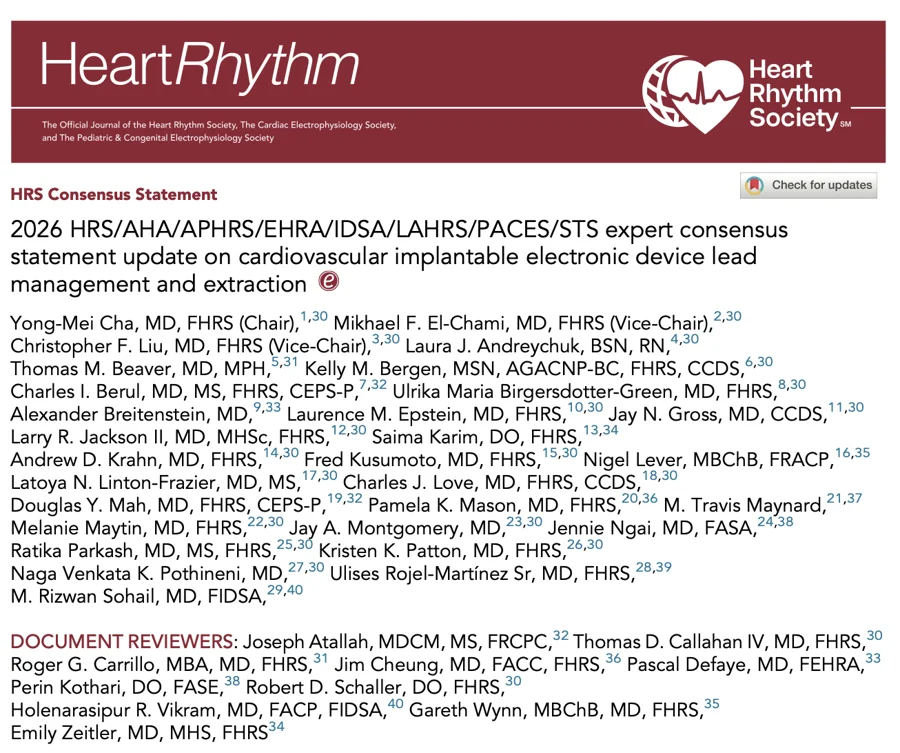
First page of the 2026 expert consensus statement in Heart Rhythm, listing the writing committee and document reviewers Download PDF · 8.5 MB

Research

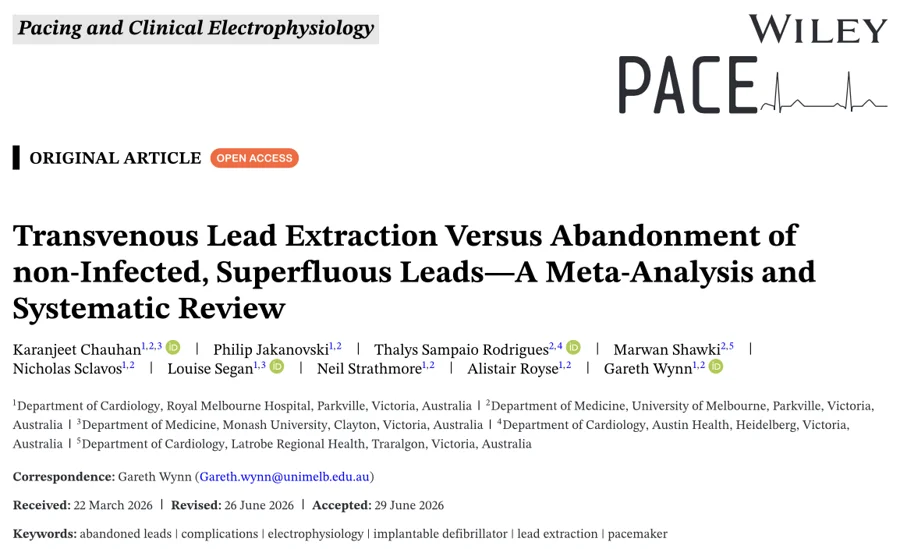
Original article · Pacing and Clinical Electrophysiology, 2026 · Open access

Transvenous Lead Extraction Versus Abandonment of Non-Infected, Superfluous Leads: A Meta-Analysis and Systematic Review

The latest research from the VELMAS team looks at leads that are no longer needed but are not infected, and whether they are better removed or left in place. Pooling 23 studies and more than 65,000 patients, it found that extraction carries a higher immediate risk, but that removing leads which had previously been left in place was markedly riskier and less often successful. This supports earlier extraction in carefully selected patients.

Authors include A/Prof Gareth Wynn, Prof Alistair Royse and A/Prof Neil Strathmore.

First page of the article in Pacing and Clinical Electrophysiology, listing the VELMAS authors Download PDF · 1.5 MB

Chauhan K, Jakanovski P, Sampaio Rodrigues T, Shawki M, Sclavos N, Segan L, Strathmore N, Royse A, Wynn G. Pacing Clin Electrophysiol. 2026. doi:10.1111/pace.70356. Published under a CC BY-NC licence.

Device infection: why early extraction matters

When a pacemaker or defibrillator becomes infected, failing to remove the device and leads promptly is linked to significantly higher short-term and 1-year mortality. These studies show why.

Cohort study · JAMA Cardiology, 2023

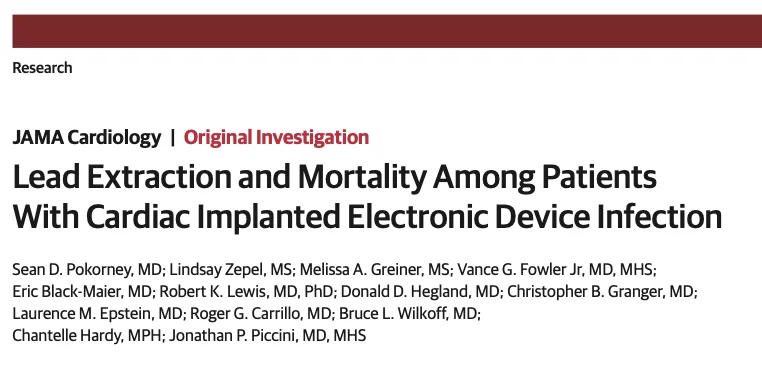
Lead Extraction and Mortality Among Patients With Cardiac Implanted Electronic Device Infection

Using US Medicare data on more than one million device implants and over 11,000 device infections, this study found that only 19% of infected patients had their device extracted within 30 days of diagnosis. One-year mortality was 32.5% for patients without extraction at 30 days, compared with 18.6% for those whose device was extracted within 6 days. Extraction was associated with lower mortality than no extraction (adjusted hazard ratio 0.82), and extraction within 6 days with lower mortality still (adjusted hazard ratio 0.69).

First page of the article in JAMA Cardiology, Lead Extraction and Mortality Among Patients With Cardiac Implanted Electronic Device Infection Download PDF · 270 KB

Pokorney SD, Zepel L, Greiner MA, et al. JAMA Cardiol. 2023;8(12):1165–1173. doi:10.1001/jamacardio.2023.3379. Open access under a CC BY-NC-ND licence.

Prospective cohort study · JAMA Cardiology, 2023

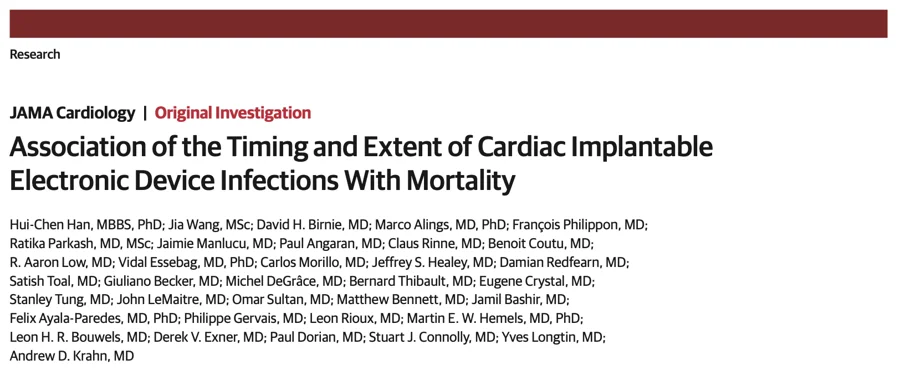
Association of the Timing and Extent of Cardiac Implantable Electronic Device Infections With Mortality

In more than 19,500 patients from 28 centres, the timing and spread of device infection strongly predicted survival. Early infections confined to the device pocket caused no deaths at 30 days, but the risk of death rose about threefold for early systemic or delayed pocket infections, and 9.3-fold for delayed systemic infections, which had a 30-day mortality of 21.7%.

First page of the article in JAMA Cardiology, Association of the Timing and Extent of Cardiac Implantable Electronic Device Infections With Mortality Download PDF · 310 KB

Han HC, Wang J, et al. JAMA Cardiol. 2023;8(5):484–491. doi:10.1001/jamacardio.2023.0467.

Retrospective study · JACC: Clinical Electrophysiology, 2021

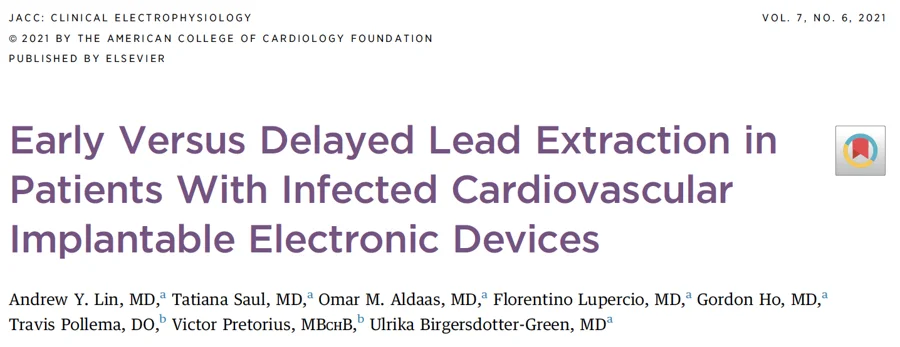
Early Versus Delayed Lead Extraction in Patients With Infected Cardiovascular Implantable Electronic Devices

Comparing extraction within 7 days with later extraction, this study found that patients with bloodstream infection whose extraction was delayed (on average 15.2 days) had around five times the odds of septic shock, acute kidney injury and respiratory failure. Delayed extraction was also associated with higher 1-year mortality.

First page of the article in JACC: Clinical Electrophysiology, Early Versus Delayed Lead Extraction in Patients With Infected Cardiovascular Implantable Electronic Devices Download PDF · 430 KB

Lin AY, Saul T, Aldaas OM, et al. JACC Clin Electrophysiol. 2021;7(6):755–763. doi:10.1016/j.jacep.2020.11.003.